2012 Workshops

The Maine Cheese Guild will host two intermediate/advanced upcoming workshops featuring instructors from away. There are still beginner cheesemaking workshops offered this spring by Appleton Creamery, and the Guild may be able to organize one or more workshops featuring Guild instructors. Stay tuned to the web site for more info.

Get Cultured

***COMPLETED**

MONDAY, MARCH 26th from 10am to 5pm
Pineland Farms Creamery, New Gloucester, Maine

1 Day workshop all about cheese cultures and molds, presented by Rex Infanger of Danisco, ideal for beginning cheese makers, as well as experienced cheese makers, because there is always more we need to know about the organisms that do all the work for us cheese makers.

British Blue Cheeses

***FILLED***

Stay tuned for an announcement about the Blue Cheese Class Ms. Biss will be teaching in Vermont if you missed this opportunity.

SAT and SUN, APRIL 21-22nd from 9am to 5pm
State of Maine Cheese Co., Rockport, Maine

British Hard Cheeses

Kathy Biss

SAT and SUN, APRIL 28-29th from 9am to 5pm

***FILLED***

State of Maine Cheese Co., Rockport, Maine

According to legend, British cheese makers have always focused on making hard cheeses because they wanted to make cheese that could survive the days and weeks of travel to market in London where a dairyman could clear a year’s wages on a single wagon-load of well found cheese. Thence came Lancashire, Cheshire, Gloucester, Wensleydale, Double Gloucester, Red Leicester, Caerphilly, not to mention a rare style named after a small Somerset village in the West Country of England: Cheddar. Kathy Biss, a British cheese maker herself, from West Highland Dairy in Scotland, will teach a class on the techniques for making and aging these types of cheeses.

These workshops are limited in size. To reserve your spot send your contact info. (including your email address) and a check for the appropriate deposit amount to:

Maine Cheese Guild
c/o Mark Whitney, Treasurer
Pineland Farms
32 Farm View Drive
New Gloucester, Maine 04260
Raw Milk Myths

There has been a lot of talk recently about how the State of Maine is against raw milk sales. Nothing could be further from the truth.

In fact, Maine is one of only 10 states that allow the retail sale of raw milk from licensed producers.

Because of this, a great quantity of high-quality raw milk is available to Maine’s cheese makers, who have taken advantage of this source to produce more and more artisanal style cheeses that are making a positive impression around the country, and consistently winning national awards.

Mainers’ access to raw milk at the retail level is threatened by the sale of unregulated raw milk. Advocates for unregulated sales of raw milk undermine the longstanding — and rare — spirit of cooperation between Maine state regulators and its licensed raw milk producers, and thus threaten the livelihood of many family farms and cheese makers across the states who depend on these raw milk sales or on access to this legal source of raw milk.

If you have any questions about this issue, please read the Maine Cheese Guild’s Quality Statement, or contact the Maine Cheese Guild directly.

Beginner Cheese Workshop Dec 6th in Orono

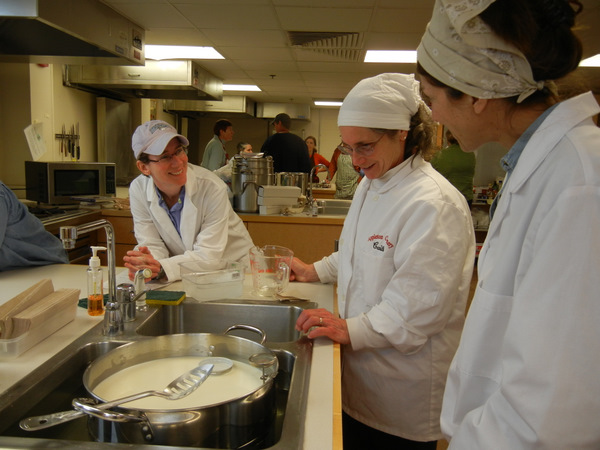
The University of Maine Cooperative Extension in Orono, along with Appleton Creamery, successfully held a Beginner Cheesemaking workshop to be held at UMaine, Hitchner Hall on Dec. 6 from 9:00am to 4:00pm taught by Caitlin Hunter (from Appleton Creamery) and Beth Calder (from the UMO Cooperative Extension program).

This workshop is taught hands-on and low tech. We had 12 people attend. We made jack, 30 minute mozzarella, and ricotta cheeses out of cows milk and co-mingled goat and cows milk for the jack. We used common kitchen utensils to produce the cheese in our Commercial Kitchen at UMaine to give beginners the confidence to produce cheese in their home kitchen (for the hobbyists). We also had people attend that may produce cheese commercially, but gives them the introduction on understanding the common cheese making steps, and provides the opportunity to experience hands-on subtle curd/texture changes that are important in producing quality cheeses.

The cows milk was organic cows milk from Grassland Farm in Skowhegan and Appleton Creamery provided the goats milk.

Beth Calder and Caitlin Hunter demonstrate how to determine the rennet set time.

Beth Calder and Caitlin Hunter demonstrate how to determine the rennet set time.

Download the flyer and application here (PDF Format).