 My grandmother used to drink a glass of buttermilk every afternoon at 4pm with a sprinkle of salt and pepper on top. Bakers swear by the use of buttermilk in biscuits as well as other quick breads where an acidic liquid helps the baking powder fluff up the dough. And those of you who attended the Culture Workshop in March will remember our instructor, Rex Infanger, waxing poetic about the enjoying good “real” buttermilk which can be hard to find these days. Read about how Kate’s Homemade Butter in Old Orchard Beach is leading the charge to regain TRUE buttermilk’s glory.
Recommended pH Meter
An often raised topic for our cheese makers is how to measure acidity, and what are the best tools for the task. Titratable Acidity kits are traditional, but messy and somewhat subjective (because it depends on the eye of the user to see pink); pH meters can be precise, but have been very expensive, delicate, and finicky.
As we learn in each workshop TA and pH both measure different aspects of the acid in our milk, whey, and curds, and they do NOT correlate, so the *best* practice is to use both methods to tell you as much as possible about what’s going on at the chemical level. Practically we all know that you can make cheese without measuring acidity at all, except by feel and taste of the curds, just as they have done for thousands of years. But the risks of bad, un-sellable batches for unknowable reasons imposes a real cost to this method of production as well.
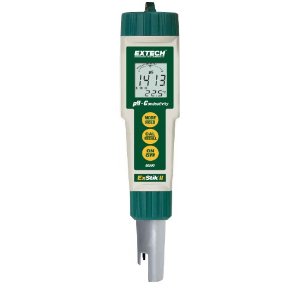 Dave Potter of Dairy Connection, Inc. led a Havarti workshop that I attended at the 2012 ACS conference, and during the make process he told everyone that he had found the “perfect” pH meter because it was waterproof, rugged (his first electrodes worked for four years before requiring replacement), the electrodes were flat so they weren’t at risk of breaking and could be used directly on the surface of draining wet cheese, it had a cap with a sponge to keep the electrodes moist, and it was relatively inexpensive. It’s the ExTech ExStik EC500 which also measures temperature and a few other things. Not surprisingly Dairy Connection sells them, but *surprisingly* they list it $20 cheaper than I could find anywhere else the Internet: $115 plus shipping. If this is your first pH meter you would also have to purchase buffers to use for recalibration (around $30 for the pH7 and pH4 buffers). You can also purchase the complete kit for the ExStik that includes cups, all the buffers, a carrying case, and other goodies. DCI doesn’t sell the kit, but you can find it elsewhere by searching for the ExTech EC510.
Happy Cows Milk Better!
At the ACS conference last month we learned how animal welfare for dairy animals can be very troubling, and what is being done to correct bad practices on a local and national level. Many folks misstated that USDA Organic rules say nothing about animal welfare (yes, even Temple Grandin got it wrong when it comes to pasture requirements for organic dairy animals), leading many dairy farms to consider other certification choices specifically on that aspect of their husbandry. At the same time it’s always nice to read the positive side of dairy farming, the way we want to think about the farms who supply us with milk, which Nicolas Kristof provides in today’s NY Times.